The Ultimate Lesson of Gallipoli
Perhaps the real message of Gallipoli is therefore not to be found back in 1915 but many years later in the expressions of reconciliation and statements of the need for peaceful solutions to conflict which come from ex-soldiers as well as from politicians. These ex-soldiers see the reality of war, the essence being that it is a human aberration and not the natural way of things.
Harvey Broadbent visited Gallipoli in December 1985 to interview Turkish veterans for the ABC television. This post-Conference article about his visit was published in the ‘Good Weekend’ (18 April 1986).
Meeting at Anzac Cove
 Meeting at Anzac Cove (Anzak Koyu), 25 April 1985 — Photo: Courtesy of David Hocking
A white bearded-old man on sturdy legs, wearing a flat cap and heavy winter overcoat, appeared around the corner of the narrow village street. He hardly seemed to need his walking stick as he stepped purposefully, a smile breaking out on his kindly grandfather face. I was shaking hands a few moments later with Adil Şahin, ex-rifleman of the 27th Battalion of the Turkish 5th Army, whose company faced the Anzacs at Anzac Cove on April 25, 71 years ago.
This meeting was special because, of the few remaining Turkish veterans of Gallipoli, Adil Şahin is the sole known survivor of the 120 or so soldiers who faced the dawn landing in 1915.
Shepherd Adil Şahin had been recruited from his village of Büyük Anafarta on the Gallipoli Peninsula as a raw 16-year-old and spent the nine months of the campaign defending the coastal front lines.
Even so, I was doubtful that he could throw any new light on the inconclusive accounts of those early days of the campaign. To remember clearly events of so long ago is a tall order. But I had found with other veterans, both Australian and Turkish, that their longevity often had crystallised certain happenings and they could recount them with surprising detail.
April 1915 turned out to be a part of his life which Adil Şahin has never been able to forget.
As we walked to his house from the centre of Büyük Anafarta, he told me that of the 33 young men recruited from his village in 1914 only three returned after the war. Büyük Anafarta — little more than three kilometres from the sea — was in the Allies’ proposed line of advance but, with determined Turkish defence, they never reached it.
Wintry, foggy weather precluded our immediate filming outside so I requested that we set up in his home. But other arrangements turned out to be necessary. Mrs Şahin, a jolly octogenarian, somewhat embarrassedly explained that they had no electricity and she disappeared to arrange for us to use a neighbour’s home.
Greeted with the traditional “Hoş geldiniz” (Your coming gives pleasure) and welcomed into the neighbour’s spotlessly scrubbed house with warm savoury pastries and glasses of tea, we eventually got down to business again. Adil explained as the videotape rolled how, just before dawn on April 25, he had been asleep in a shallow trench with other riflemen just above the beach at the southern end of Anzac Cove when the duty watch awakened them urgently.
“He shook us and pointed down the slope to the water below,” Adil said. “He said he thought he could see shapes out there on the water. We looked out and strained to see in the half light and then we heard noises and saw shapes of boats with soldiers coming ashore. We were ordered to start firing. This we did as the Anzacs came ashore. (Adil did not find out until much later that these men were Australians.) Some fell on the beach and I wasn’t sure whether we’d hit them or they were taking shelter.
“They made for the base of the rise and then began climbing. We were outnumbered, so we began to withdraw.” (They withdrew to the second ridge, where they dug in as reinforcements began to arrive.)
My Turkish assistant and I drew as many memories as we could from Adil over the next hour. A special moment came as we talked about the evacuation.
He had made some observation about the difference between the Turkish trench systems and those of the Allies which he saw later. Then he said that he had seen something on the floor of one trench. He reached for an inside pocket, searching for an item that he obviously had planned to reveal to our cameras at the right moment. He had a sense of theatre which proved valuable later when I was able to record him on Anzac Beach. But, unfortunately, the timing with the hidden object was ruined by its refusal to emerge. I helped him and eventually we found it — a cap badge inscribed “Australian Military Forces.” Adil had kept it all those years. He contemplated it and sighed, a resignation to the folly of war.
As he looked up and talked about the way a reconciliation between the Turks and the Australians had been achieved, the corner of one eye moistened and he asked me to give his best wishes to the Australian Gallipoli veterans he had met the year before when they had travelled back to attend the ceremonies which marked the official naming of Anzac Cove by the Turks. The connection between that hat badge of 1915 and, 70 years on, the Anzac Cove meetings so moved Adil that I ended the interview.
The Battlefield
The fog had lifted enough to record Adil in the surroundings of his village. I also took the opportunity to record Adil on the battlefield. He was pleased to be asked to do this and, having regained his strength, soon was revelling again in being at the centre of attention.
Driving round the curve of Ariburnu Point, suddenly being there and seeing the familiar landmarks from the old photographs — the Sphinx, Plugge’s Plateau, the beach itself — provoked a tingling feeling and a perceptible increase in my pulse rate.
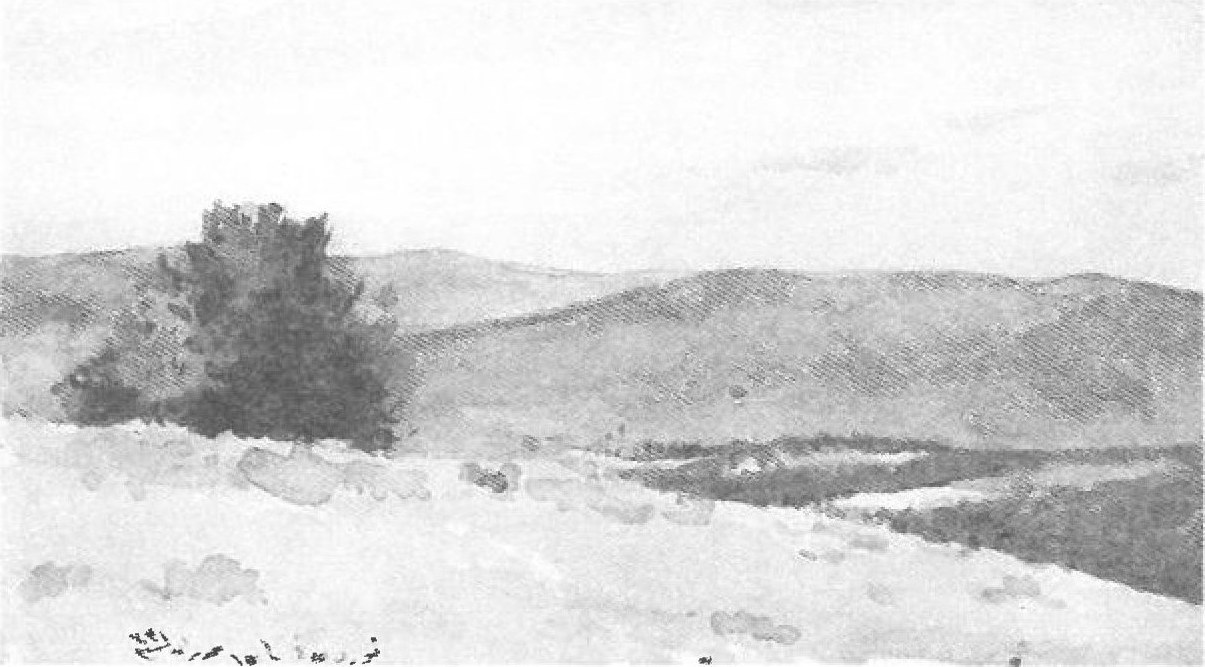
The place had a peaceful beauty. In the weak winter sunlight, tinged with the remnants of blue mist and in spite of all the sad and unpleasant connections with the past, the landscape was irresistibly and strangely appealing. The starkness of the yellow ravines and bare rock outcrops contrasting with the greens and purples of the shrub vegetation was impressive.
Of course, Australians in 1915 would not have been so well disposed to this landscape but one such veteran to whom I had spoken had commented that some of the sunsets over the sea and the peninsula were something to behold.
Other Australians who have visited Gallipoli have told me that the landscape affected them much as it did me. It’s hard to put the feeling into words. It is certainly not a feeling of depression, as I half expected, in spite of knowing that the bones of so many men whose lives were forfeited in this place might lie beneath my feet. The best I can do is to express it as a feeling of peaceful melancholy — a natural, remote beauty which has reluctantly become a cemetery.
Most people know how the Allied campaign has been condemned as being ill-conceived and badly executed, although not so many know the details as to why this is so. Seeing the area close up for the first time, some of those details became graphically clear.
Anzac Cove and the beach between the headlands of Ariburnu at the northern end and Little Ariburnu seemed surprisingly short, 200 metres at the most, but more surprising still was its narrowness. Between the waterline — which varies little with the tides — and the steep rise, the beach was only a matter of 10 metres at most. What a daunting task to have such a place as a bridgehead for the 4,000 troops who landed first on April 25. The rise to the top of the first ridge, although not sheer, was steep enough to elicit an exclamation from me and tuts from the Turkish crew when I told its members what had happened at this place.
This rise has now been effectively bisected five metres above the beach by a road built originally some time after the evacuation and recently given a loose-topped surface. We taped Adil walking along this road and then, as he tired, sitting on Anzac Beach looking thoughtfully to sea. He pointed out to us his position at dawn on the first day, on Little Ariburnu, and where he saw the first Australians coming ashore just below.
This was somewhat surprising, as it is generally accepted that the first boats touched ashore further north toward Ariburnu itself. The boats Adil saw at Little Ariburnu could, of course, have been landing simultaneously with those further north but he insists that the units at Little Ariburnu were the first ashore.
It was here, too, that I realised that Anzac Cove — for many years a neglected place — was no longer so remote. Apart from the road on which I had seen two cars pass in the hour we spent there, there was evidence of visitors — even the remains of a picnic littering the very spot where Adil said those first Australians had climbed from the beach. Two figures, apparently Turks, were wandering through the scrub half-way up the first ridge. By all appearances, they were seeking relics.
With the memorials so well established as neat parks with footpaths, reconstructed trenches and gardens, the War Graves Commission (operated by the British) expects more Turkish and foreign visitors — especially Australians — to journey there.
From the tourist route on the Dardanelles (which takes you to the somewhat disappointing ruins of Troy and further on to Pergamon and Ephesus) the offshoot to Anzac takes about half-an-hour by car. You can go by taxi or negotiate the hire of a mini-bus for a group. An Australian Tour Company red double-decker bus visits the peninsula twice weekly on its run between Europe and Asia. Well-surfaced roads serve the area.
A cold wind started up as we finished filming on the beach and I remembered that there had been snow on the peninsula, in November 1915. The sky now looked heavy and grey, so I decided to try to get shots of the Turkish positions before the weather closed in.
At Chonkbayir (Chunuk Bair), where the most crucial Turkish defence took place in August 1915, great concrete monoliths like a modern Stonehenge celebrated the victory of August 9. On that day, exhausted New Zealanders were pushed off the summit a few hours after having taken it with a magnificent rifle and bayonet attack.
The Turkish trench lines on the summit are still clearly discernible as deep indentations in the earth. Some trenches have been reconstructed.
Much of the strategic outlook from Chonkbayir which made it so important a position for the Turks to hold in 1915 has been blocked by the pine trees which have grown on or below the summit.
And there are many pine trees at another place where once was only one and then for only a few weeks in 1915. So many Australians and Turks died in savage hand-to-hand fighting at Lone Pine on August 7.
In one of the saddest places of the peninsula, the pines surround neat gardens filled with the memorial stones which chronicle the toll on the youth of a generation.
Inscribed on one stone is:
62 TROOPER G. R. SEAGER 9TH AUST LIGHT HORSE 7 AUGUST 1915 AGED 17 HE DIED A MAN & CLOSED HIS LIFE’S BRIEF DAY ERE IT HAD SCARCE BEGUN
Further north, at the infamous Quinn’s Post where horrific bomb throwing between the trenches took many lives, a narrow road runs where no man’s land lay. The indentations are clearly visible on either side. The opposing trenches almost touched. I tried lobbing a few rocks from one side of the road to the other. It was easy to be accurate.
It amazed me that anyone survived Quinn’s Post.
One important question was answered for me on seeing where Mustafa Kemal, the Turkish hero of Gallipoli who rushed to counter the Allied attacks, made his headquarters after the Anzac landing.
This was on a hill three ridges from the sea, which became known as Kemal Yeri (Kemal’s Place). It was where Turkish High Command (Kemal was only a divisional commander at that stage) ran the peninsula defences. Views of all battle zones to the south and west were clear from Kemal Yeri. Mustafa Kemal (later Kemal Atatürk, first President of the Turkish republic) had found it and made what turned out to be his second most crucial and telling decision of that first day.
His first crucial decision was that the Anzac landing was the major assault and not a diversionary attack as his High Command believed. Kemal held no forces in reserve, as he had been ordered to do.
For me, all this viewing of the battlefield was a reconnaissance. I shall have to return to film in summertime. This trip was to gather the first in-depth interviews with Turkish veterans. It was time to take Adil Şahin back to his village and return to Istanbul.
The Parting
As we set off from Anzac Cove, the sun left us and the fog started down again.
The parting was warm. Mrs Şahin gave us the largest bag of walnuts I have seen. Along with it came an apology that the walnuts were all they could offer in winter.
But there was more. Mrs Şahin handed us a branch of an olive tree. I had been wondering whether the talk of “peaceful reconciliation” was mere politicians’ platitudes, designed more with diplomatic expediency in mind than truly felt sentiments. I had been suspicious that I would find the Turkish veterans less than benevolently disposed toward former enemies.
While they still maintain their attitude that the Anzacs were invaders, time has mellowed them. The olive branch given so spontaneously to an Australian film crew on the Gallipoli Peninsula 70 years to the week after the evacuation was sufficient proof to me that the spirit of reconciliation is deeply felt by these ordinary Turkish folk.
Thirty of Adil Şahin’s friends and 86,000 of his countrymen were killed by Australian and other British troops in 1915. I could not help thinking as I held that branch that such small gestures and the bigger ones such as the renaming of Anzac Cove were magnanimous and probably unique.
Australia has reciprocated by naming a park near the War Memorial in Canberra, as well as a stretch of coastline near Albany in Western Australia (where the AIF convoy sailed in 1914) after Kemal Atatürk.
Perhaps the real message of Gallipoli is therefore not to be found back in 1915 but many years later in the expressions of reconciliation and statements of the need for peaceful solutions to conflict which come from ex-soldiers as well as from politicians. These ex-soldiers see the reality of war, the essence being that it is a human aberration and not the natural way of things.
Gallipoli Casualties
April 25 – December 20, 1915 · an area of 20 kilometres by eight
- 86,000 Turkish and Ottoman
- 8,700 Australians
- 2,700 New Zealanders
- 27,000 British and Indian