Johnny Turk Before Gallipoli
19th Century Images of the Turks
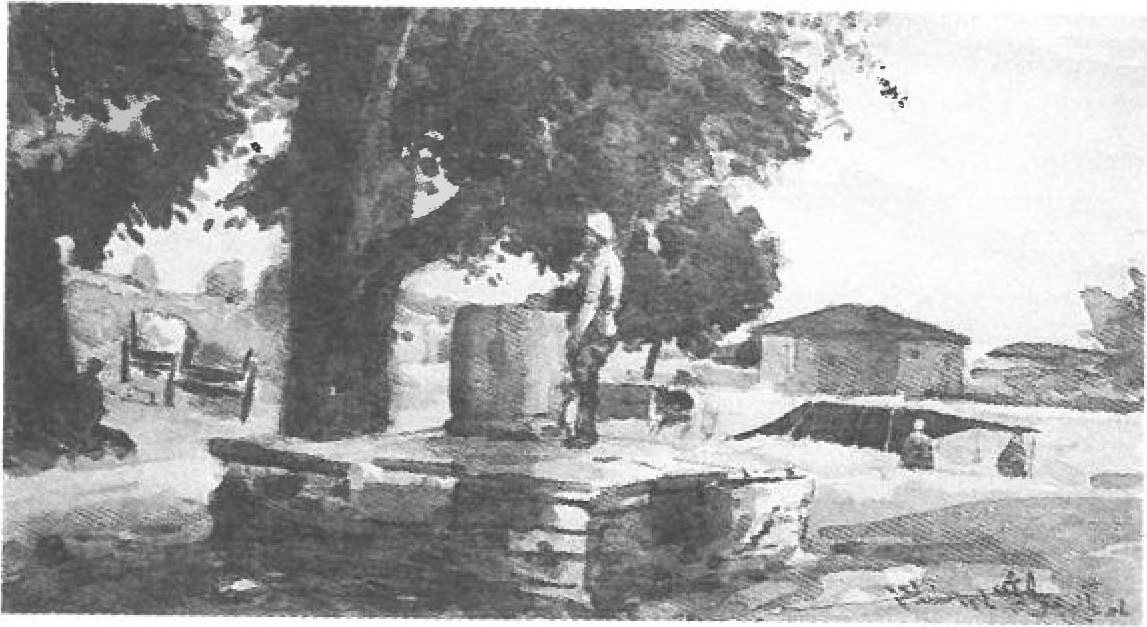
Foreign observers talked of the Turks as nomads and intriguers yet no peasant could be more truly wedded to the soil than the Anatolian Turk - and no government practised intrigue more effectively in the 19th century than those of Europe.
The body of this paper is concerned with images of the Turks as they developed among Europeans in the 19th century. In particular, I am concerned with the attitudes towards the Turks which came to prevail in England, a country whose interests - political, economic and religious - in the Ottoman state developed strongly in the 19th century. A few preliminary remarks are perhaps necessary to explain how this came about.
England’s Strategic Interests
England’s interests in the Ottoman Empire of the 19th century were largely shaped by its rivalry with other imperial European powers and particularly with Russia.
The intrigues of these two great and rapidly expanding powers stretched from Afghanistan and the principalities of Central Asia across and into the Balkan provinces of the Ottoman State and the need to block Russian expansion in this region became one of the principal foreign policy objectives of successive British governments.
If the Russians attained their historic goal of taking control of Constantinople and the straits connecting the Black Sea and the Mediterranean, they would be in a vastly improved position should the two powers come into open conflict. Britain’s maritime supremacy in the Mediterranean could be threatened, as could the sea route connecting both ends of the British Empire.
These were some of the strategic concerns which led Britain to believe that the Ottoman State should be maintained as a bulwark against Russian expansion if for no other reason.
Religious and Economic Dimensions
Economic and strategic concerns aside, there was also a religious flavor to English interests in the Ottoman State. This was true of many of the European powers. Whether in Bulgaria, Palestine or on Mt. Lebanon, they were deeply involved in the affairs of local Christian communities and these communities often became sounding-boards for European interests.
Any changes in the status of Christian minorities came to be regarded over a period of time as reflecting some kind of change in the relative standing of European powers.
The Crimean War, it must be remembered, was triggered off by a seemingly petty dispute between the Latin priests and the Orthodox over which of them had the right to hold the keys to the Church of the Nativity in Bethlehem.
When the sultan decided in favor of the Latin priests, the Tsar took offence because it appeared to him that the sultan was ruling in favor of France as well as the Latins and against Russia as well as the Orthodox.
The Crimean War was in fact “a conflict between Russia on the one hand and Britain and France on the other to see who would dominate the Middle East politically and economically as the Ottoman Empire declined”1 but it was the dispute between the priests that set it off.
European interests in the affairs of Christian communities were not entirely self-motivated. The growth of imperialism in the 19th century was set in a framework of moral and humanitarian imperatives, according to which the spread of European influence was a duty on the part of those fortunate enough to have been born Anglo-Saxon and Christian. That it was of inestimable value to those on the receiving end went without question.
The moral arguments were given force by the practical achievements of imperialism - surely a sign of God’s favor. The British Empire alone spanned vast continents, in which a handful of Englishmen were able to control the lives of millions of other people, a phenomenon which could surely only be explained (as one writer put it in 1878) by the “extraordinary moral force attaching to the superior over an inferior race”.2
The theory of race superiority readily meshed in with the notion of religious superiority.
Assuming that “western civilisation and Christianity were two aspects of the same gift which they were commissioned to offer to the rest of mankind”3, it was no wonder that wherever European consuls and European missionaries were found they were often looked on by the local people as the same enemy in different clothes.
Few countries offered so fertile a field for mission work as the Ottoman Empire, with its profusion of so called nominal Christians awaiting redemption and guidance towards a better form of Christianity, and with its millions of Muslims who might one day be brought into the fold.
Christian-Muslim Relations
The history of Muslim-Christian relations in the 19th century forms a tangled skein but the belief amongst missionaries and their supporters back home that the Christians formed an oppressed minority, subject to the depredations and exactions of the “Mohammedan” government, was a principal source of anti-Turkish feeling.
Of course the Christians had genuine grievances but so did the Muslims as travellers through the Ottoman Empire were able to confirm.
When William Gifford Palgrave made a consular trip to supposed centres of Muslim fanaticism in 1868, he was able to conclude, after making extensive inquiries amongst Muslims and Christians and observing how they lived, that maladministration in high places “injured Christians and Mohammedans alike but more frequently the latter than the former”.4
In 1879, the British consul in Jerusalem wrote to his ambassador in Istanbul that the greatest sufferers from official corruption and abuse in Palestine were the rural Muslims, “the bone and sinew of the country … whilst every other community can and does in case of need appeal to the protection and sympathy of powerful advocates, the Mussulman has no-one to look to”.5
Elsewhere another British consul writes of a new vali or governor treating Moslems and Christians and rich and poor with cruel impartiality in seeking the prompt discharge of real or fictional obligations.6
The most onerous obligation of all - conscription - did not even apply to Christians.
We can gauge its effect on the Muslim population and its impact on village and family life from this report7 written from Palestine in 1887:
The heaviest drain of able bodied men from Palestine for army purposes which has occurred in ten years has been imposed on the province in the present year. About 5000 recruits and reserves have already been shifted from here to Constantinople and the work still goes on. The present draft here takes one out of every seven of the male population.
Facts such as these tended to balance out the picture of Ottoman society cultivated by missionary groups and their supporters in England and the United States. But they were largely overlooked, as were the reform measures undertaken by successive Ottoman governments.
In the 19th century there was a fairly common view that the Ottomans only talked of reforms when they wanted to get the Europeans off their back - as they supposedly did after the Crimean War and after the Russo-Turkish war of 1878.
Again there was evidence to the contrary.
Richard Wood, one of the most outstanding British consuls of the 19th century and a man familiar with all parts of the Ottoman State, wrote in 1877 that it was unfair to tax the Ottoman government with insincerity in its “laudable efforts” to give effect to reform measures. He wrote8:
When we consider what it cost many continental Nations more advanced in civilisation to improve their institutions, it lessens our surprise if the radical change of those to which the Mohammedans were habituated for ages and the substitution of others in their place, and these others imagined by many to be borrowed from Christian nations, should have met with opposition or should have been ill understood. Such a state of feeling would have a natural tendency to retard the execution of the promulgated reforms.
That these reforms were genuine and that they sprang from the wishes of Ottoman sultans and their ministers rather than from European prodding there is little doubt. The scale on which they were applied and their successes and failures have been well documented by contemporary research within Ottoman archives.
The Question of Equality
A specific sore point within the reform question was the question of absolute equality for Muslims and Christians.
Ottoman reformers found it difficult to translate the equality promised by the Hatt-ı Hümayun (Imperial Rescript) of 1856 into practice largely because of the hostility of conservative Muslims who believed that the Islamic foundations of the state were being undermined.
The problem was particularly acute in the attempts of the reformers to replace Islamic law with secular codes and to establish secular courts of law.
A Council of State with Muslims and Christian members was established in 1856, secular schools were established and Christians were elected to provincial advisory councils but as the American Ottoman scholar Roderic Davison has written, progress was slow and “no genuine equality was ever achieved”.9
In criticising the Ottoman government for its lack of progress in the reform areas, European critics often ignored or understated the difficulties involved.
An extension of the question of equality was the belief of missionaries and their supporters that reform decrees such as the Hatt-ı Hümayun of 1856 and the Hatt-ı Şerif of 1839 were charters sanctioning the full range of their activities. These included not only the establishment of schools and churches but attempts to convert Muslims.
Missionaries approached Muslims in the knowledge that apostasy was a capital offence under Islamic law. The penalty had on rare occasions been applied, to the outrage of European governments.
In 1880 the Sultan Abdul Hamit himself remarked that any Muslim was free to embrace Christianity, even the Sheikh ul Islam himself. But in practice, the sultan said, “there were parts of the empire where the population was not only very fanatical but frequently almost beyond the control of local functionaries when their fanaticism was aroused … the public appearance of a converted Mussulman might lead to serious disorders and even a massacre or persecution of Christians for which he and his government would be held responsible.”10
The Ottoman Government did not agree with missionary interpretations of reform decrees and occasionally tried to restrict their activities by closing missionary rooms and seizing their literature.
When it did so there were loud cries of protest. It was said that the Porte’s sole motive was to “degrade and crush Protestantism”11 and that the promised religious liberty had been narrowed down to a practical negation of it altogether12 and missionaries continued to regard the Hatt-ı Hümayun, in particular, as the Magna Charta of what they called the “subject races” of Turkey.13
Shifting Images of the Turks
From what I have said so far it can be seen that images of the Turks shifted ground constantly throughout the 19th century depending on circumstances.
During the Crimean War “Johnny Turk” was regarded as a stout ally and resolute soldier, yet on other occasions he was seen only as a bloodthirsty and fanatical Muslim.
At no time was the metamorphosis of Johnny Turk from one to the other more striking than during the Bulgarian agitation movement of the 1870s, set afoot in England under the leadership of W.E. Gladstone.
The massacres of Bulgarian Christians as reported in the London press caused a ferment of popular revulsion against the Turks. Wrote The Economist: “The crimes charged against Turkish troops in Bulgaria are of a kind against which the manly nature of Englishmen revolts with a sickening repulsion not easily overcome nor forgotten”.14
In his famous sixpenny Pamphlet, Bulgarian Horrors and the Question of the East, Gladstone demanded that the Turks be sent packing ‘bag and baggage’ out of Europe, describing them in the following terms15:
It is not a question of Mohammedanism simply but of Mohammedanism compounded with the peculiar character of a race. They are not the mild Mohammedans of India nor the chivalrous Saladins of Syria nor the cultured Moors of Spain. They were, upon the whole, from the first black day when they entered Europe, the one great anti-human specimen of humanity. Wherever they went a broad line of blood marked the track behind them: and as far as their dominion reached, civilisation disappeared from view. They represented everywhere government by force, as opposed to government by law. For the guide of this life they had a relentless fatalism: for its reward hereafter, a sensual paradise.
In vain did the Ottoman Government protest that the British press was exaggerating, that Bulgarian Christians incited by outside agents had provoked the situation and that many Muslims had been killed. Years later Abdul Hamit recalled that when he drew evidence of Christian atrocities against Muslims to the attention of the European ambassadors they simply shrugged their shoulders and said nothing.16
The upheaval in Bulgaria was quickly followed by war between Russia and Turkey. In the early stages of the war the dominant public sentiment in England was that Britain should not help the Ottomans because of the treatment of Bulgarian Christians. As a friend wrote to the British ambassador in Istanbul: “Society is very much distracted between its two aversions - the Merciless Turk and the Barbarian Russ but I am inclined to think that the Turk is the least liked of the two”.17 All this began to change as the Russians advanced on Istanbul, the occupation of which would present a direct threat to Britain’s imperial interests.
At the Congress of Berlin in 1878 the Russians were forced to disgorge the spoils of war, to the benefit of just about everyone but the Ottomans, who were treated as incorrigible rascals who would be given one last chance. Whether good use would be made of this last chance or whether it would be thrown away would depend - Lord Salisbury wrote - on the sincerity with which Ottoman statesmen now addressed themselves to the duties of good government and the task of reform.18
As Mr Punch put it in his own fashion, if the Turks pulled their socks up “then Punch will undertake that John Bull will stand your friend and that it shall be Bono Johnny again, as in the old Crimean days. But if not … don’t trust to England to stand your friend”.19
There was, of course, a good deal of hypocrisy in Britain’s attitude. Beaconsfield and Salisbury had gone to Berlin to look after Britain’s interests, which they did by filching Cyprus from the Ottoman State (as Mr Gladstone put it) and by claiming the right to establish some sort of protectorate over Eastern Turkey.
Britain’s attitude is nicely summed up in the fable told by Sir Philip Currie, later British ambassador to Istanbul20:
Some travellers arrived at an out of the way inn and asked for something to eat. There was nothing but the little girl’s pet pig which with many tears she gave up. It was killed and roasted and the travellers sat down to dinner. The little girl was still heard crying. One of the travellers went out to see what was the matter and found that she was crying for a slice of the pig.
European Interpretations of Ottoman Decline
The kind of sentiments expressed by Gladstone during the Bulgarian agitation surfaced repeatedly during the nineteenth century as European observers tried to understand and explain to others the root causes of the problems afflicting the Ottoman State.
Here was a state which had been involved in two major wars in the nineteenth century alone, as well as minor ones and a host of insurrections and uprisings. The Crimean War alone had left it with economic difficulties that would continue for the rest of the century.
The financial pinch was felt in virtually every area of life and to complicate matters for the sultan and his ministers there were the incessant pressures of European governments on a variety of issues and the rise of national feeling among ethnic and religious minorities.
One would have thought that these complications went a long way towards explaining the slow decline of the Ottoman Empire but there was no shortage of experts who found that the basic problem lay with Islam and/or the nature of the Turks.
There were, of course, those who had lived amongst the Turks and Muslims and took a more positive and charitable view. Consul Wood, mentioned before, believed that the reforms undertaken by the Ottoman government, far from being retarded by Islam, were in perfect accord with its principles. Lord Dufferin believed that Islam was essentially democratic, and in Turkey in Europe, published in 1877, James Baker wrote21:
We have the evidence of all impartial men who have lived amongst the Mohammedans and studied their character to the effect that they compare favorably with Christians in all the virtues which unite in making up the generic word morality.
General Gordon wrote22:
I like the Mussulman … he is not ashamed of his God. His life is a fairly pure one. Certainly he gives himself a good margin in the wife line, but at any rate he never poaches on others. Can our Christian people say the same?
Sir Richard Burton, one of the greatest European scholars of Islam, dismissed charges of sensuality made against Islam as being the product of the grossest ignorance.
On the other hand, times of turmoil in the Ottoman State, particularly the Bulgarian crisis of the 1870s and the Armenian crisis of the 1890s, produced torrents of anti-Islamic and anti-Turkish propaganda - particularly in England and the United States.
Islam was held up as a sensual and depraved religion, a religion which destroyed all progress and happiness, a religion which ruled by the sword and which regarded the killing and plunder of infidels as being as much an act of worship as prayer.
Notwithstanding its fair show of outward observance and its severe legal enactments, wrote a Church Missionary Society cleric in 1875, there is something in Islam which strikes at the very root of morals, poisons domestic life and (in its truest sense) disorganises society. Freedom of judgement is crushed and annihilated and a barrier has been raised not merely against the advance of Christianity but against the progress of civilisation itself.23
It was quite appropriate that during the Armenian agitation in the 1890s, Punch magazine should have portrayed the aging Mr Gladstone and the Duke of Argyll as crusaders, riding forth on chargers with lance in hand.
Not since the Crusades - it was argued - had there been greater cause for European intervention in the Muslim world.
As most Turks were Muslims it was logical to apply to them the same epithets used against Islam, and thus the characteristics of a religion were transmuted into the characteristics of a people. Islam was inherently cruel, sensual and depraved, and, it was argued, so were the Turks. It was said of them that when they ceased fighting “they seem to fall into a normal state of sloth, sensuality and decay”.24
One clerical author found evidence of a moral corruption so hideous that he could not bring himself to mention it by name; it was enough to say that the cities of the Plains (Sodom and Gomorrah) were destroyed for sins which were the normal everyday practice of this people.25 Even Gladstone resorted to this line of attack against the Turks, referring to their “gross and horrible vices”.26
These were extreme views - views which we may find funny or insulting - but even those less motivated by religious animus and in a better position to know, found something peculiarly Turkish at the root of the misfortunes of the Ottoman State.
Wrote an American official from Palestine27:
The Oriental is influenced by selfish motives in conferring favors and receiving them. Services performed and past are readily forgotten. Only those who know Turkey and none know the Turks except those who have lived amongst them can comprehend the extent and applicability of the term intrigue: nor will it be deemed too much to say that the counsels and administration of the Government are mainly carried on by treacherous machinery. Living under a despotic government, under laws framed to screen the authorities rather than protect people, in a land where might makes right, where justice, or judgment rather is bought and sold, the people are suspicious, cowardly, revengeful and being without education, without commerce, except on a very small scale and without employment comparatively, they make vice and intrigue and pleasure the business and the employment of life.
This situation could only be understood within a broader historical setting, and the same author of the above passage went on to write:
The Turk terms himself an Ottoman, that is to say, a descendant of Othman, a predatory chief, half prophet, half robber. His descendants have squatted in Europe and in Asia Minor but they have never become wedded to the soil that they occupy any more than a herd of locusts. Their scheme of government is a theocratic one and their laws are based on their interpretation of the Koran. In the last century European powers have sought to convert these marauders into a nation and they have signally failed in the attempt. Wars have been undertaken on their behalf and money has been showered on them, but they go from bad to worse and each succeeding year they become more feeble, more corrupt and more effete. They are a doomed race and the sooner that we realise this fact the better it will be for the world.
Alexander Terrell, the American minister at Istanbul in the 1890s, had ample opportunities for observing the economic, political and social problems that were dragging down the Ottoman State and he was by no means unsympathetic to the Turks, yet even he felt that without culture, without even a proper language of his own and considering it beneath his dignity to do any work which he could get a Christian to do for him, the Turk “has been content to seek delight in women and war rather than in the pursuit of commerce, of art or of science”.28
There was some truth in some of these statements but a great deal more falsehood and exaggeration. Educated Muslims - educated Turks - did not deny that the Ottoman State had fallen behind the west in scientific progress.
Foreign observers talked of the Turks as nomads and intriguers yet no peasant could be more truly wedded to the soil than the Anatolian Turk - and no governments practised intrigue more effectively in the 19th century than those of Europe.
In falling back on prejudiced or ill informed racial, religious and social generalisations many European observers of Ottoman society overlooked or ignored or were ignorant of the true causes of Ottoman decline.
These lay not in some intrinsic characteristic of the Turk or of his religion but in internal political, economic and social developments and in the Ottoman State’s interaction with outside powers - usually to its own disadvantage.
Conclusion
The images of the Turks given here are often negative, even though the Turks always had their defenders in government and out. From what I have said it can be seen that the words Turk and Muslim were used interchangeably and frequently pejoratively. I would argue that much of the animosity expressed towards the Turks in the 19th century and the eagerness to interpret the failings of the Ottoman State in religious, racial or ethnic terms was part and parcel of the centuries-old Christian polemic against Islam.
This is not an evangelistic age and the religious fervor associated with 19th century England has faded away but people still tend to see Turks in extremes - the valiant soldier as he was at the Crimea or Gallipoli or the debauched and sadistic individual portrayed in ‘Midnight Express’.
Bridging these extremes and showing ‘Johnny Turk’ as he really is - as an amalgam of the same strengths and weaknesses and hopes and aspirations as other national groups - should be one of the principal tasks of the Society organising this Conference.
References
-
SHAW, S.J. and SHAW, E. History of the Ottoman Empire and Modern Turkey, Vol. II (Cambridge, 1977), p. 134.
-
DICEY, E. Nubar Pasha and Our Asian Protectorate, The Nineteenth Century, September 1878, p. 549.
-
CRAGG, K. Sandals at the Mosque. Christian Presence and Islam, London, 1959, p. 5.
-
Great Britain, Parliamentary Papers, Turkey No. 16 (1877), Cd. 1739, inc. in No. 1.
-
Great Britain, Parliamentary Papers, Turkey No. 4 (1880), Cd. 2537, inc. in No. 5.
-
Great Britain, Parliamentary Papers, Turkey No. 4 (1877), Cd. 1730, inc. 2 in No. 2.
-
U.S. National Archives, Jerusalem Consulate, Gillman to Porter, No. 10, December 16, 1886.
-
Great Britain, Parliamentary Papers, Turkey No. 1 (1878), Cd. 1905, No. 574.
-
Davison, R. Turkish Attitudes Concerning Christian Muslim Equality in the Nineteenth Century, American Historical Review, Vol. 59, 1953/54, p. 848.
-
Great Britain, Parliamentary Papers, Turkey No. 19 (1880), Cd. 2708, No. 23.
-
Great Britain, Parliamentary Papers, Correspondence Respecting Protestant Missionaries and Converts in Turkey (1865), Cd. 3433, No. 2.
-
ibid. No. 34.
-
Violations of the Hatt-ı Hümayun. A paper prepared by the Evangelical Alliance of Constantinople at the request of Sir Philip Currie (New York, 1895).
-
The Economist, August 12, 1876, p. 943.
-
Bulgarian Horrors and the Question of the East (London, 1876), p. 9.
-
U.S. National Archives, Constantinople Legation, No. 214, March 17, 1894.
-
WATERFIELD, G. Layard of Ninevah (London, 1963), p. 365.
-
SETON-WATSON, R.W. Disraeli, Gladstone and the Eastern Question, (London, 1935), p. 500.
-
Punch, July 1, 1896.
-
British Library, Layard Papers, add. ms. 39014, Currie to Layard, July 26, 1877.
-
BAKER, J. Turkey in Europe (London, 1877), p. 491.
-
MOOREHEAD, A. The White Nile (London, 1976), p. 195.
-
HUGHES, T.P., Rev. Notes on Muhammedanism (London, 1875), p. X.
-
RICHARD, H. (MP). Evidence of Turkish Misrule, Eastern Question Papers No. 1 (London, 1877), p. 3.
-
DENTON, W., Rev. The Christians of Turkey. Their Condition Under Mussulman Rule (London, 1876), pp. 65-66.
-
SHANNON, R.T. Gladstone and the Bulgarian Agitation (Sussex, 1975), p. 34.
-
U.S. National Archives, Jerusalem Consulate, No. 85, April 30, 1880.
-
U.S. National Archives, Constantinople Legation, No. 1029, October 22, 1896.